
How LED Video Walls Are Transforming Live Events in South Florida
For years, projection was the default way to put visuals on a stage. Across Broward, Miami-Dade, and Palm Beach, LED video walls have quietly taken over, and they are changing what a live event can look and feel like.
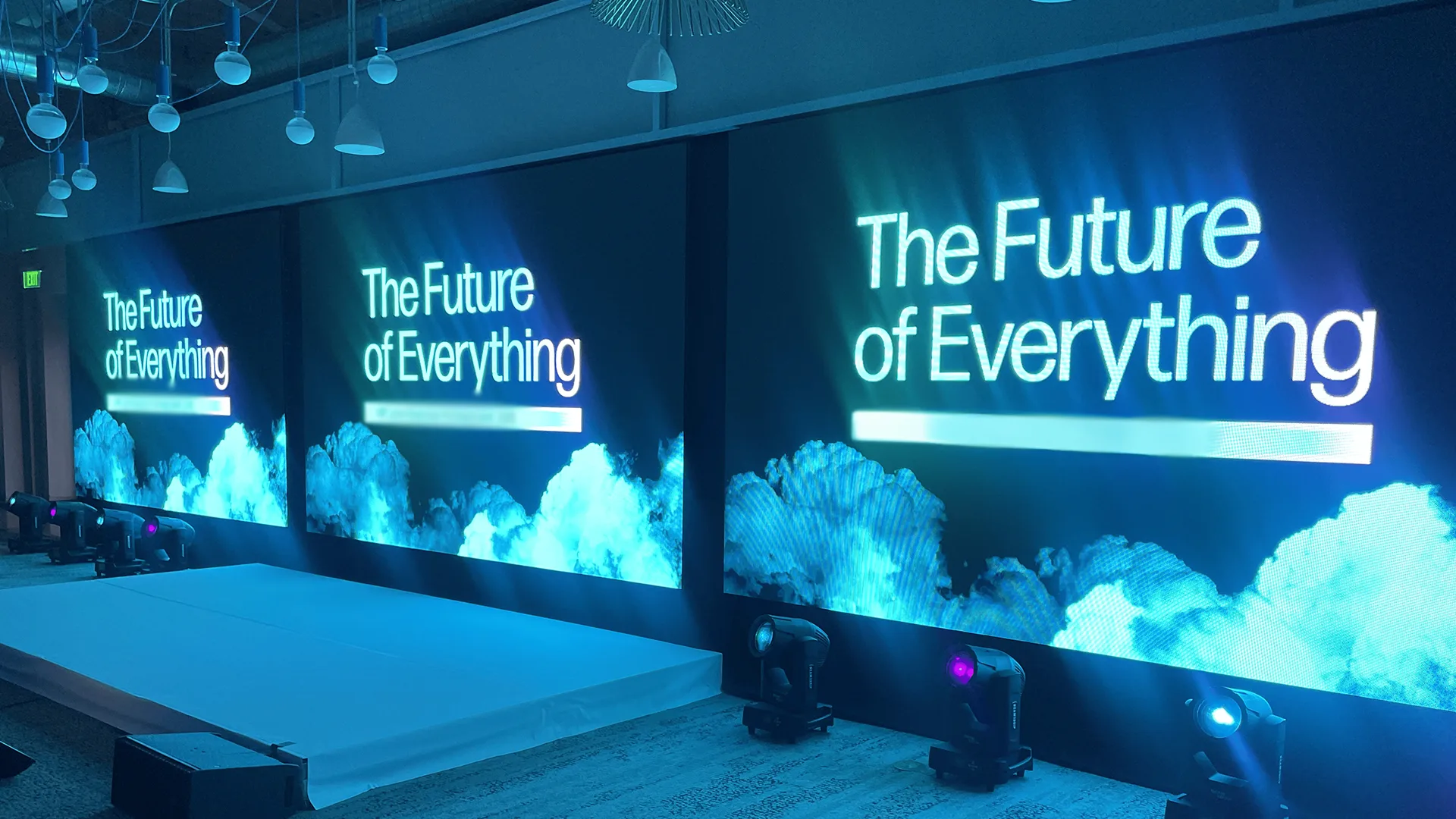 Cover Image
Walk into a corporate keynote, a gala, or a product launch in South Florida today and the screen behind the stage is almost certainly an LED video wall, not a projection screen. The shift happened fast, and it happened for good reasons. LED walls solve the two problems that used to haunt every event producer in this part of the world: light and flexibility. If you have ever watched a projected logo wash out the moment the house lights came up, you already understand why the change matters.
This is not a story about new gear for the sake of new gear. It is a story about what becomes possible on stage once the screen stops fighting the room and starts shaping the experience. The technology has matured to the point where the question is no longer whether an LED wall will look good, but how you want to use it. That is a better problem to have, and it is the reason producers across the region have stopped asking for projection by default.
Brightness That Wins the Room
Projection works by throwing light onto a surface, which means it is always competing with every other light in the space. In a dim theater, that competition is manageable. At a South Florida event, it rarely is. Sunlight pours through ballroom windows, stage washes hit the screen, and uplighting bounces everywhere. A projected image in those conditions looks gray, soft, and tired.
An LED video wall produces its own light. Instead of reflecting a beam, every pixel emits brightness directly at the audience, so the image holds up under house lights, stage lighting, and even daylight. Colors stay saturated, contrast stays sharp, and the content reads clearly from the front row to the back of the room. For the kind of bright, polished productions our clients want across event production, that reliability is the whole game. The visuals look intentional, not like a compromise the audience has to squint through.
The practical effect on a show is that the lighting designer is no longer at war with the screen. With projection, you constantly trade one off against the other: turn up the stage wash and the visuals fade, dim the room to protect the image and the speakers disappear into shadow. An LED wall removes that tug of war. You can light a presenter properly, hit the room with color, and run vivid content on the wall at the same time, all without any of them stepping on the others. For an event that has to feel energetic and on brand from the first second the doors open, that freedom is the difference between a stage that looks produced and one that looks improvised.
Flexibility That Changes the Stage
The second advantage is shape. Projection needs a flat surface and a clear throw distance, which boxes you into a rectangle hung in roughly the same spot every time. LED walls are built from modular panels, and that single fact unlocks an enormous amount of creative freedom.
- Any size. Panels tile together, so the wall can be as compact as a single accent screen or as wide as the entire back of a ballroom.
- Any shape. Curved arrays, towers, archways, and floor-to-ceiling backdrops are all on the table, because you are assembling a canvas rather than aiming a beam.
- Any placement. Without a throw distance to protect, the screen can sit directly behind speakers, frame a runway, or wrap a corner without a projector blocking sightlines.
- Any room. The same modular system adapts to a hotel ballroom in Fort Lauderdale, a convention hall in Miami, or an outdoor stage in West Palm Beach.
- Any moment. Because the panels reconfigure, the inventory that built a wide keynote wall this morning can become side towers for a gala that night.
That adaptability is why LED has become the default for ambitious staging. The screen is no longer a flat panel the speaker stands in front of. It becomes part of the set itself. And because the panels are repeatable units, a producer can scale a concept up or down to fit the budget without redesigning the whole show.
Creative Staging You Could Not Do Before
Once the screen can be any size and shape, the line between video content and physical set design starts to blur. A wide LED backdrop can shift an entire room from a sponsor wall to an immersive environment between segments. Content can extend the architecture of the stage, frame a presenter in a branded world, or react in real time to what is happening in front of it.
This is where strong production planning earns its keep. A wall is only as good as what runs on it, so the staging, the lighting design, and the motion content all have to be built together. When those pieces are planned as one system rather than handed off between separate vendors, the result feels designed rather than assembled. That coordination is exactly the kind of work that lives best under one roof.
It also changes how a run of show flows. Because the wall can carry the look of an entire scene, transitions that once needed a hard blackout and a scramble behind the curtain can now happen in plain sight. A keynote backdrop dissolves into an awards environment, then into a sponsor reel, without the room ever going dark or losing momentum. That continuity keeps an audience engaged through the parts of an event that used to drag, and it gives the production a rhythm that feels closer to broadcast than to a slideshow.
Projection asks the room to cooperate. An LED video wall stops asking. It produces its own light, takes its own shape, and lets the stage become the experience instead of just holding it up.
What It Means for Your Audience
For the people in the seats, the difference is immediate even if they never name it. The image is brighter and easier to read, so the content does its job from anywhere in the room. The visuals feel like part of a deliberate environment rather than a slideshow on a screen. And because LED walls support live camera feeds with crisp clarity, the audience in the back row gets the same close-up view as the people up front, which matters enormously at larger events.
There is a comfort factor too. A bright, even wall reduces the eye strain that comes from staring at a dim projection for an hour, so attention holds longer. When the room is dialed in, people stop noticing the technology at all, which is the goal.
That clarity carries straight into the broadcast as well. When you pair a bright, high-resolution wall with live streaming, the remote audience sees the same vivid stage your in-room guests do, instead of the washed-out projection that used to define so many streamed events.
Where Permanent Installs Fit In
Not every LED wall is a temporary build. Many South Florida venues, houses of worship, corporate lobbies, and government facilities are moving to permanent LED installations, so the capability is always on hand. A fixed wall removes setup time from every event and gives an organization a flexible canvas for daily content, town halls, and gatherings alike.
That is where event production and AV installation meet. Whether you need a wall for a single show or a permanent fixture wired into a building, the planning, the content pipeline, and the support behind it are the same craft. Getting both from one team keeps the brand, the quality, and the accountability consistent from the temporary stage to the permanent install. For government clients, that single point of accountability is often the whole reason to consolidate.
Choosing the Right Wall for the Job
LED is not a single product, and the right specification depends entirely on the event. Pixel pitch (the spacing between LEDs) determines how close an audience can sit before the image breaks up, so a wall built for a stage backdrop seen from across a ballroom is different from one viewed up close in a lobby. Brightness, panel size, and structure all shift with the venue and the use case.
Power, rigging, and content resolution matter just as much as the panels. A wall that draws clean power and hangs safely from the right structure is the part of the job an audience never sees but always feels. The content has to be mastered to the wall's real resolution too, or even the best panels will show soft, stretched graphics that undercut the whole effect.
The point is not to memorize the specifications yourself. It is to work with a team that asks the right questions about your room, your audience, and your content before recommending anything. With more than 21 years staging events across South Florida, we have learned that the best LED wall is the one matched to the moment, not the biggest one on the truck. Founded in 2005 and CBE-certified in Broward County, we have watched this technology go from a premium upgrade to the standard every serious production now plans around, and we have built the workflow to match.